What shoppers see when they tap your product in ChatGPT
 By Daniela Ricaud, founder of Pretty Citable
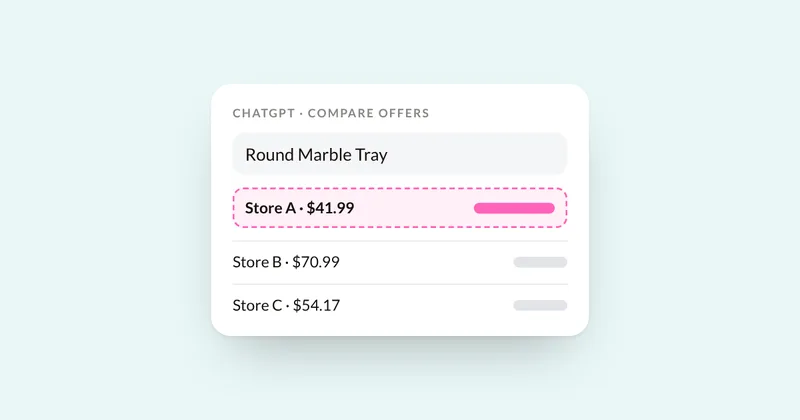
When a shopper taps a product card in ChatGPT, a product panel opens inside the chat. It lists every store ChatGPT found selling that product, each with a price, a stock or delivery line and a Visit button, plus a rating and a short description ChatGPT writes. OpenAI says those offers can come at the same or different prices, and that ChatGPT may write its own product title because stores often use different titles for the same product. So the price and name of your product at every retailer can sit side by side, one tap after the recommendation.
What I saw after one tap
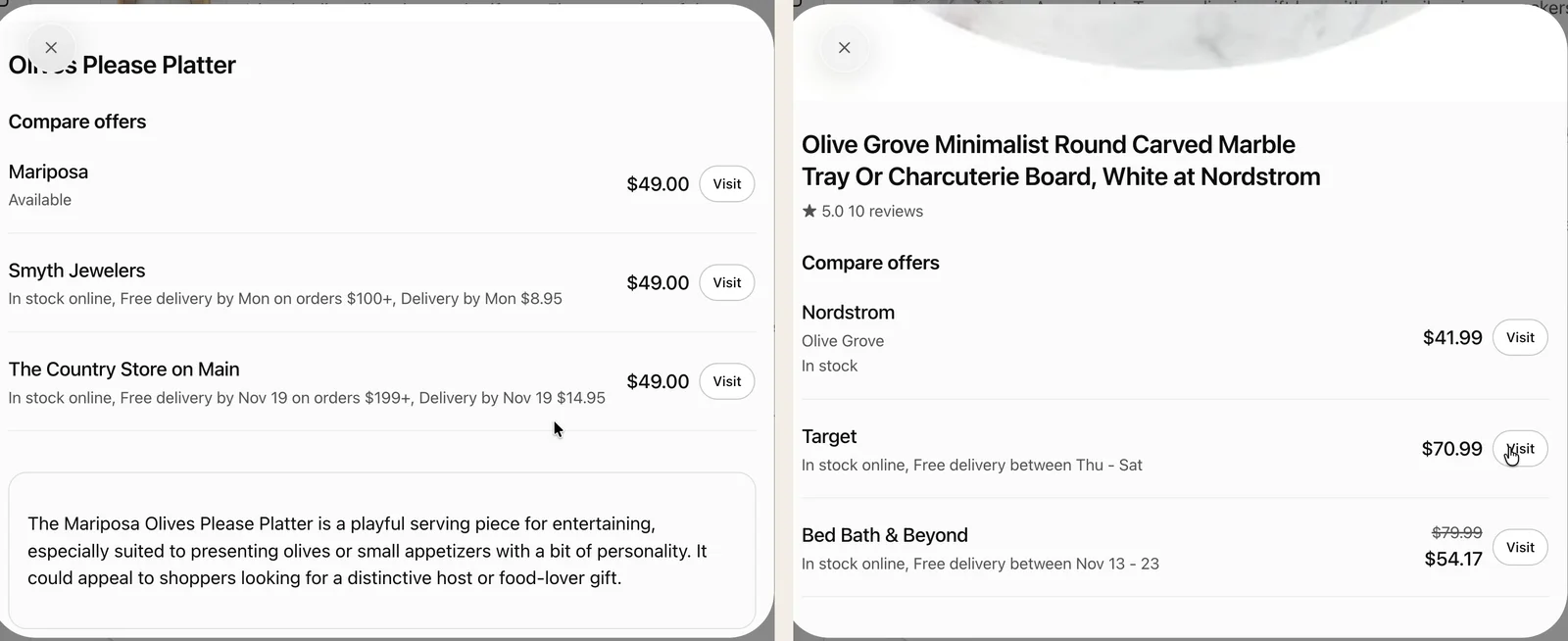
On November 11, 2026, I asked ChatGPT "Best hostess gift under $50 USD", logged out in a private window, for Day 1 of our Who's at the table? series. Then I tapped every product card in the answer. Each tap opened a panel with:
- The product title, with a star rating and review count when ChatGPT had one.
- "Compare offers": each store, its price, a stock or delivery line and a Visit button.
- A short description ChatGPT wrote about who the product suits.
Three things the panels showed
One product, three stores, one price. The Mariposa Olives Please Platter showed $49.00 at Mariposa, Smyth Jewelers and The Country Store on Main. Mariposa's own product page lists the same $49.00. With the name and price matching at every store, the only differences in the panel were the delivery lines.
One product, two names, three prices. The panel for a marble tray was titled "Olive Grove Minimalist Round Carved Marble Tray Or Charcuterie Board, White at Nordstrom". It listed three offers:
- Nordstrom at $41.99, with Olive Grove named as the brand
- Target at $70.99, where Target's own page calls it "Storied Home Minimalist Round Carved Marble Tray or Charcuterie Board, White"
- Bed Bath & Beyond at $54.17, marked down from $79.99
ChatGPT showed all three as one product, so the shopper saw a $29 spread and two brand names in a single panel.
The same rating on two different products. The Ladolea olive oil and salt gift set and a set of Williams Sonoma mini oil cruets both showed 4.5 stars from 122 reviews. The panel doesn't say where a rating comes from.
Of the five products with a shop link, two showed three stores and three showed one.
What OpenAI says about these panels
OpenAI's help center describes the same experience:
- Product results are selected by ChatGPT, and OpenAI says they aren't ads. Ads appear separately, labeled as sponsored.
- After a shopper selects a product, they may see other merchants offering it, at the same or different prices.
- The merchant list is built from merchant and product data supplied by third-party providers or by merchants directly.
- ChatGPT may write simplified product titles and descriptions, because merchants often use different titles for the same product.
- When more than one merchant offers a product, the lowest price may get a "Best price" label. I didn't see that label on the tray panel, where Nordstrom was the lowest.
- Shopify stores are already connected through Shopify Catalog. Other merchants can apply to share a product feed with OpenAI.
Why this matters for your brand
- Your retailers' listings sit next to yours. If a retailer prices your product differently, or names it differently, the shopper sees that in the same panel as your own store.
- The lowest price can get the label. Per OpenAI, a retailer's discount on your product may carry a "Best price" label beside your full-price offer.
- Your own store may not be listed. For the Ladolea set, the only store in the panel was Williams-Sonoma. Whoever is in the panel is where the shopper clicks next.
What to check this week
- Tap your own product. Ask ChatGPT the questions your buyers ask, logged out in a private window. When your product shows up, tap it and write down every store, price and title in the panel. Here's the full method.
- Match name, price and contents everywhere you can. Start with any retailer listing that's priced differently from your site or uses a different product name.
- Make sure your own store can appear. On Shopify, OpenAI says your catalog is already connected through Shopify Catalog. On other platforms, look at OpenAI's product feed application. Either way, your product pages need to be readable. Here's how to get your products recommended.
- Check again before Black Friday. Black Friday is November 27. Repeat the check after any price change or holiday discount, on your site or a retailer's.
Want this checked for you?
The AI Visibility Audit tests 30 of your buyers' questions on ChatGPT, Google AI, Perplexity and Claude, shows which brands get named in your place, and ranks what to fix first. It includes a listing check: I tap your top three products in ChatGPT and flag every store, price or product name that doesn't match your site. It's $500, with the report in 5 business days. Or start with the free 60-second check.
Sources
- OpenAI Help Center: Using shopping research in ChatGPT
- OpenAI Help Center: Shopping with ChatGPT Search
- OpenAI: Powering product discovery in ChatGPT (Mar 24, 2026)
- Pretty Citable: Who's at the table? Day 1, Best hostess gift under $50 (Nov 11, 2026)
See where your brand stands
Run three buyer questions yourself in 60 seconds, or get the full AI Visibility Audit: 30 questions on four engines, a competitor map and a ranked fix list in 5 business days.