How I test your brand, engine by engine.
The method behind the audit: the 30 questions, the three runs on four engines, what each engine reads, and how I check my own work. If you only want the short version, the audit page has it.
What ChatGPT says a good audit covers, and where ours covers it.
I asked ChatGPT, logged out, "Is an AI visibility audit worth it for a Shopify brand?" It listed what a worthwhile audit should cover, and warned: "The biggest mistake would be paying for an expensive audit that simply gives you an AI visibility score." Here is each point, matched to this audit.
| What ChatGPT said a good audit covers | Where it is in this audit |
|---|---|
| 20 to 30 real customer questions | 30 buyer questions built from your products (01) |
| Visibility across ChatGPT, Perplexity, Gemini and Google AI | ChatGPT, Google AI Overviews and AI Mode, Perplexity and Claude (02). Gemini runs on Google's index, the same source as AI Overviews and AI Mode. |
| Competitor visibility | Every brand named in your place, and the sources each engine trusts for them (03) |
| Brand reputation and citations: publications, reviews, Reddit | Cited sources for every answer (03), your profiles and retailer listings (05), and Reddit Reviews for US brands |
| Product discoverability | Missed questions (04) and the listing check of your products in ChatGPT (06) |
| Technical AI readiness: crawlable pages, schema, product details | Crawler access, structured data and product details, ranked in your fix list (07) |
| Repeatable testing, because one answer isn't proof | Every question asked three times on four engines, with dated screenshots, and the same questions re-tested in every Program |
| Measurement: AI visits, conversions and revenue | The audit reads public answers, so it doesn't measure your sales. Your report shows how to see AI visits and sales in GA4 and Shopify, and Programs track them monthly. |
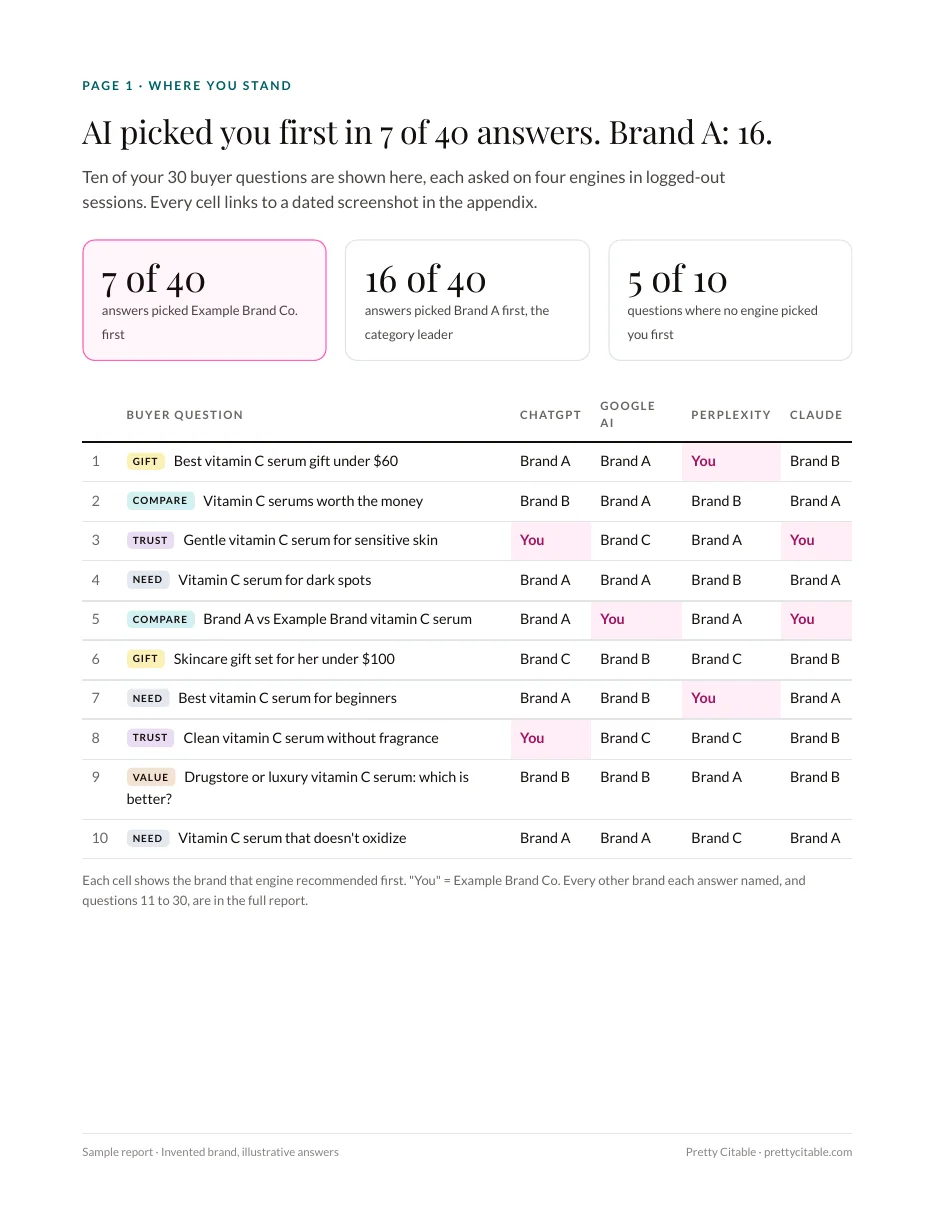
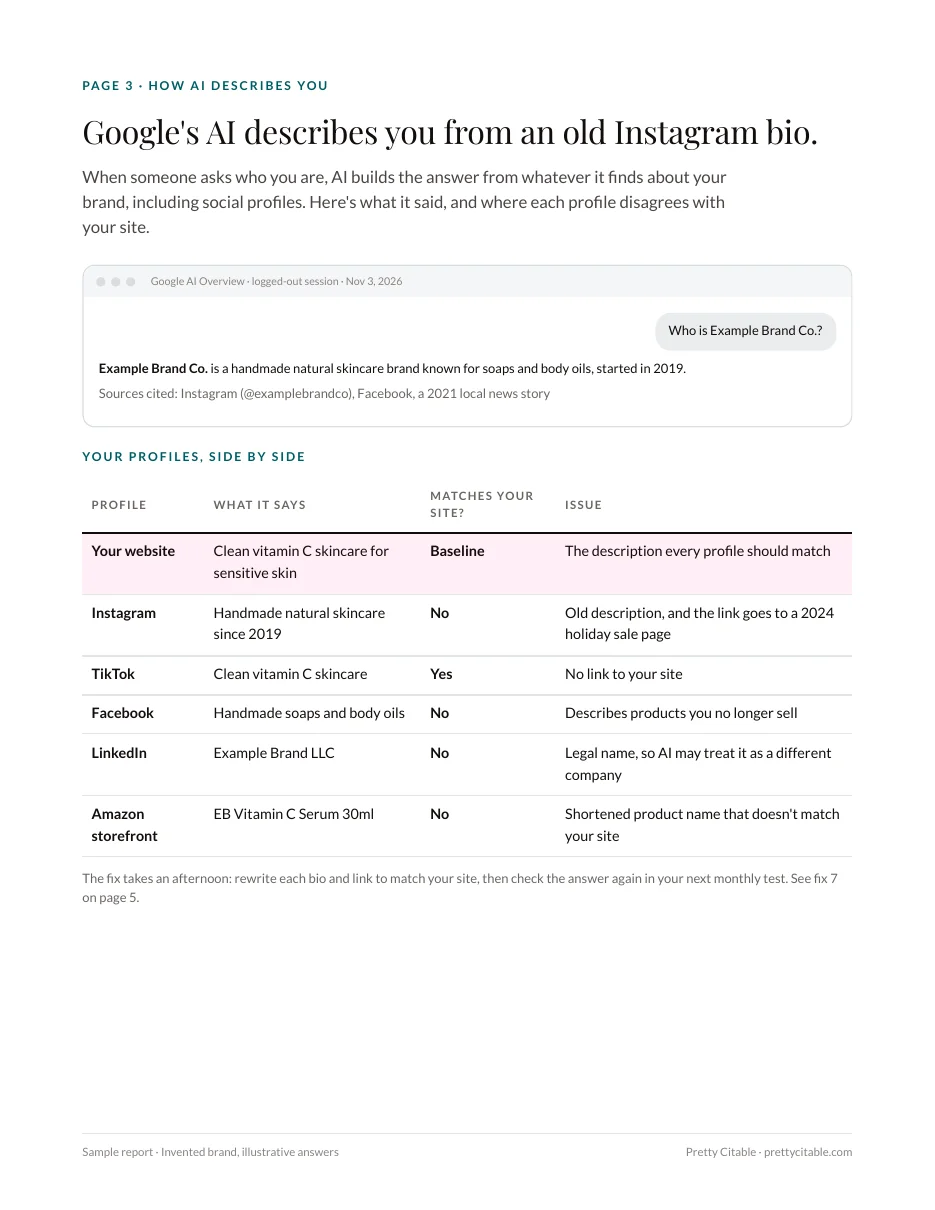
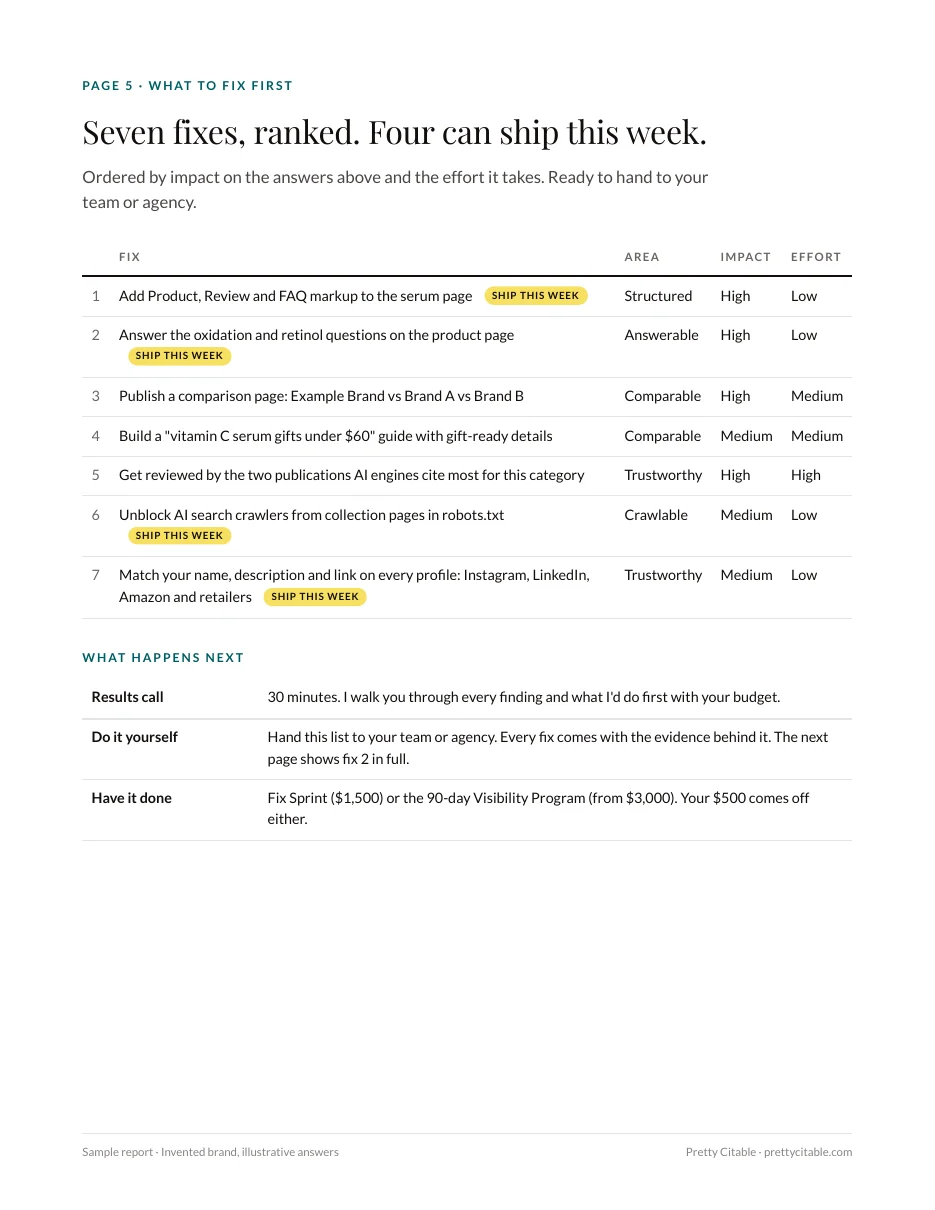
Pages from the sample report, which uses an invented brand. Download all nine pages.
Three layers decide whether AI names you.
You've probably heard all three terms. Here's what each one does. SEO is the first layer, and AI needs the other two before it recommends you.
- 1SEOGoogle can find youCan Google find your pages and rank them?A fast site Google can read, the right keywords, and links from other sites. If you already pay for SEO, this layer is likely covered.
- 2AEOAI can quote youCan AI pull a clear answer from your pages?Product pages that answer buyer questions directly, plus product and FAQ markup so AI knows what each page is about.
- 3GEOAI recommends youDoes AI trust your brand enough to name it?Reviews, press, gift guides and comparison pages that mention you, and the same brand details everywhere you appear.
The audit checks all three layers and shows which one is costing you the sale. Check it yourself first
Every engine reads a different part of the web.
Good SEO is the starting point. Each AI engine then adds its own sources, so showing up takes a different fix for each one.
| Engine | Where its answers come from | What helps a brand show up | Source |
|---|---|---|---|
| Google AI Overviews, AI Mode and Gemini | Google's own search index | Pages Google already trusts; YouTube is the most-cited domain in AI Overviews | BrightEdge via 5W |
| ChatGPT | Web search, with tests showing Google among its sources. Only about 8% of the pages it cites rank in Google's top 10 (Ahrefs, 2025) | Lists, reviews, forums and retailer listings that mention you | Search Engine Land |
| Perplexity | Live web search, with sources cited inline | Reviews, community discussions and original data | AirOps |
| Claude | Brave's independent search index | Being findable and well linked across the open web | Xponent21 |
What is AI visibility?
AI visibility is how often, and how accurately, AI assistants mention and recommend your brand when people ask questions in your category. You'll also hear it called AI search visibility or LLM visibility. It covers ChatGPT, Google AI Overviews, AI Mode and Gemini, Perplexity and Claude.
Each engine builds its answer from what it can find and trust about you: your product pages, reviews, press, videos, gift guides and the pages that compare you with competitors. Pretty Citable measures where you show up today and fixes the gaps, so AI can find you, quote you and recommend you.
A clinic site I rebuilt now gets cited in Google's AI Overview.
I rebuilt the clinic's service pages so search engines and AI could read them: one clear answer per page, clean technical access, structured data and stronger content signals. Traffic stayed flat through February. I started the rebuild in March, and clicks climbed from there.
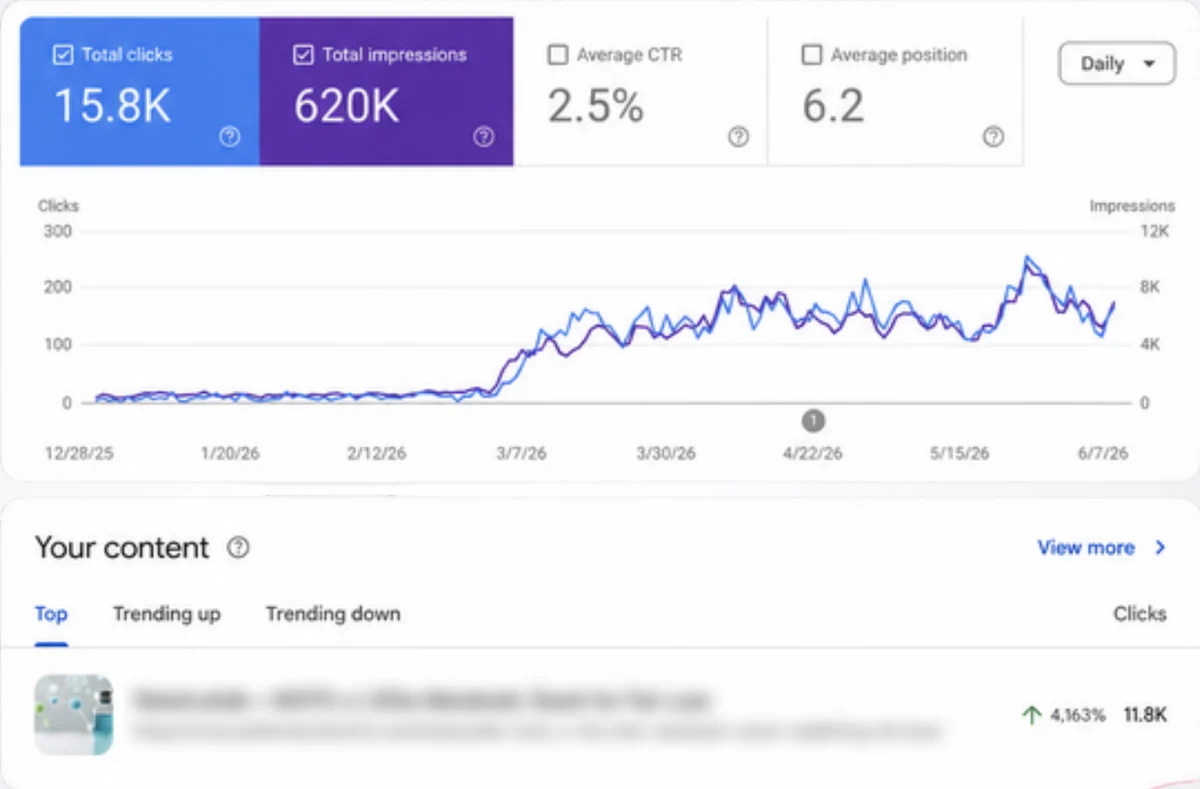
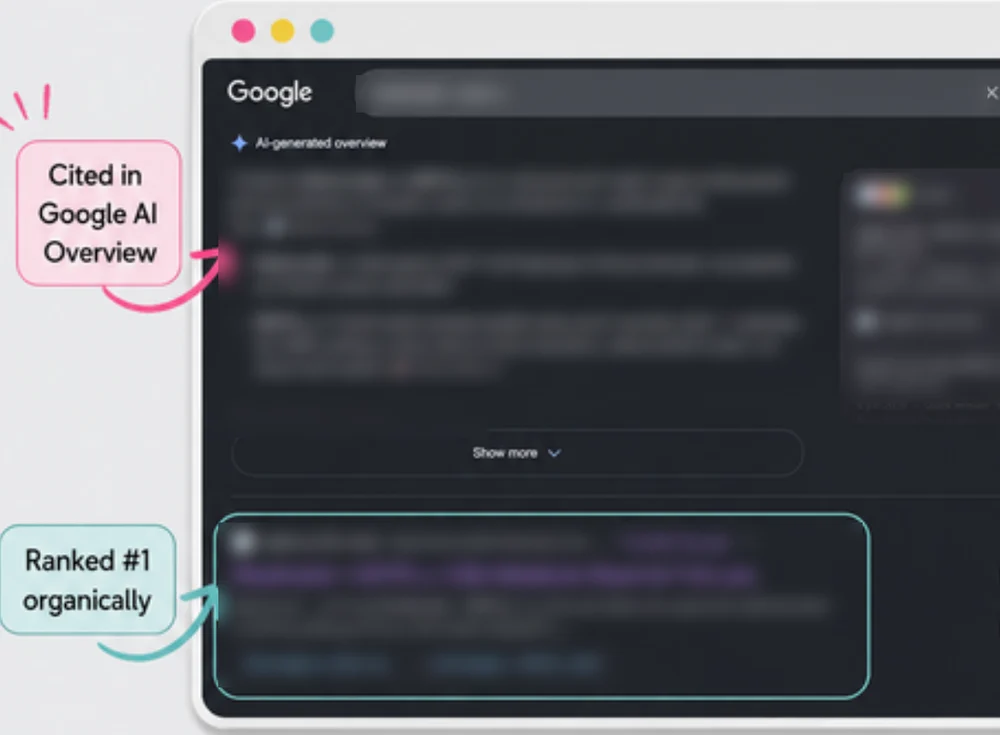
One site, shown with the owner's permission. Results depend on your category and competition, and nobody can promise rankings.
The same fixes work on product pages.
AI engines judge every page with the same three questions: can they reach it, can they understand it, and can they trust it? Here's what I fixed for the clinic, and what the same fix looks like on your store.
| What I fixed for the clinic | The same fix on your store |
|---|---|
| One clear answer per page | Product pages that answer buyer questions directly: who it's for, what it does and how it compares |
| Clean technical access | Collections and product pages that Google and AI crawlers can reach and index |
| Structured data | Product, review and FAQ markup, so engines know exactly what you sell and what buyers say about it |
| Stronger content signals | Comparison pages, gift guides and best-for pages, the formats AI likes to quote |
Can you guarantee my brand shows up in ChatGPT?
No one can guarantee that, because AI answers change daily and no one controls them. I guarantee the work, the deadline and at least three fixes you can act on, and I measure what changes every month.
How long does it take?
Five business days from the moment I have your website, your top products and three competitors you watch.
What do you need from me?
Your website, your top products or collections, three competitors you watch, a rough monthly marketing budget and your average order value, so I can recommend the right next step. A rough number is fine. That's it.
Do you need access to my store?
Not for the audit. It tests what AI engines say about you in public, so I only need your website, products and competitors. In the Program I write the pages and your team or developer publishes them, so I never need your store login. If you'd rather I publish, a staff or collaborator account works.
How soon will AI start recommending us after the fixes?
It varies by engine and by how competitive your category is, so nobody can promise a date. Crawlers have to revisit your pages, and third-party mentions take time to build. That's why every Program re-tests your questions at day 30, 60 and 90 and reports exactly what moved.
How do you tell sales from AI apart from normal demand?
With three signals, because no single report shows it. AI referral visits in GA4 and Shopify (chatgpt.com, perplexity.ai and similar sources), what AI actually recommends when your buyers ask (the dated screenshots in your audit), and what customers say when you ask how they found you. Some AI influence never shows up as a referral, so I report all three side by side and never claim a number the data can't support.
Can you fix Google AI Overviews for my product category?
I can fix what Google's AI reads. The audit tests your category's buyer questions in Google AI Overviews and AI Mode, shows which pages Google cites for them today, and ranks the fixes that make your pages the better source. Nobody controls what Google shows, so I don't promise a placement. Every audit includes a re-test 30 days after your fixes, and the Program re-tests every month, so you see exactly what moved.
Does claiming my ChatGPT Business Hub listing help me show up more?
Not by itself. Claiming lets you correct your details, add a product feed and see ChatGPT's own mention and click counts, and OpenAI says claiming doesn't change how often ChatGPT recommends you. Every audit checks whether your listing is claimed and your feed is connected, because the counts are useful and the details stay yours to fix. How to claim it.
Do you count sponsored results as recommendations?
No. ChatGPT now shows ads, and Google's AI Mode shows sponsored products and sponsored stores inside its answers. Your report flags every paid placement separately, so an ad never counts toward your seat rate or a competitor's. I also ask ChatGPT about your brand by name on a free account and note whose ad shows up: in Seer Interactive's study of 161 recorded sessions, a question naming one brand returned a sponsored card for a different company in 5 of 6 categories tested.
Can you pay to get recommended by ChatGPT or Google AI?
ChatGPT now shows ads on its Free and Go plans in the US and many other countries. OpenAI says those ads are labeled, shown separately from the answer, and don't influence ChatGPT's answers or the products it picks. So paying OpenAI buys an ad slot. My work targets the answer itself: clearer product pages, better product data and real mentions on the sites AI reads. I never buy placements, links or reviews.
Will ChatGPT's Business Hub replace an audit?
They do different jobs. Business Hub, which OpenAI launched in beta on November 10, 2026, lets you claim your listing and shows how often ChatGPT mentioned you, how many clicks that sent and the topics that came up. It doesn't show the questions, it doesn't compare you with competitors, and it covers ChatGPT only. The audit shows the questions, the brands named in your place and what to fix, across four engines. Claim your listing either way: it's free. How to claim it.
Is AI visibility worth it compared to regular SEO?
You don't have to pick one. Google says its AI Overviews and AI Mode have no extra requirements beyond being eligible for regular Search, so most fixes help both. AI still sends far less traffic than Google, but it's growing fast, and Adobe found AI visitors to US retail sites converted 90% better than other visitors in September 2026, up from 31% better in the 2025 holiday season. The audit shows where your brand stands on both before you spend more.
Our code is frozen for Black Friday. Can the fixes skip a developer?
Many of them can. A lot of what an audit finds is text: product names, descriptions, gift and FAQ answers, and your listings on retailer sites. On most store platforms your team edits those in the admin, with no code release. Each fix in your report says who can make it, so the text fixes can go first and anything that touches your theme, robots.txt or structured data waits until your freeze lifts.
Can this hurt my SEO?
The fixes I recommend are the ones Google already asks for: pages its crawler can reach, accurate product data, clear answers, and structured data that matches what the page shows. Google says its AI Overviews and AI Mode have no extra requirements beyond regular Search, so the same work serves both. I don't use hidden text, pages written only for AI, or anything Google's spam policies warn against, and nothing changes on your site without your team's yes.
What if AI says something wrong about my product?
The audit flags it. I check what each answer says about your products against your own site: price, sizes, materials or ingredients, and stock. Every mistake gets a dated screenshot. Then I trace where the wrong fact comes from, often an old retailer page, a review site or outdated copy of your own, and your fix list says what to correct first. Here's the step-by-step version.
Where are you based?
Pretty Citable is a remote studio. I work in English with ecommerce and DTC brands that sell in the US and the UK, during US business hours on Central time (UTC-6). It's a trading name of Amadito Holdings Ltd, registered in England and Wales.
If I rank on Google, will ChatGPT cite me?
Ranking helps, and it isn't enough on its own. In Ahrefs' study of 15,000 prompts (August 2025), only about 8% of the pages ChatGPT cited in its answers ranked in Google's top 10 for the same question. For Google's AI Overviews, it was 76%. Google rankings mostly carry over to Google's own AI, and ChatGPT draws on a much wider set of pages: lists, reviews, forums and retailer listings. The audit shows which pages each engine cites for your buyers' questions.
Do you have an ecommerce client whose AI visibility improved?
Not yet. My published case study is a service business. Two ecommerce brands start the founding pilot on November 20, get re-tested in late December, and the before-and-after goes on this site in early January, with their permission. Until then, the proof is public: the Thanksgiving series with every run dated, the vitamin C research, and my own scorecard.
Can you show before-and-after results across all four engines?
Not yet, because I don't have an ecommerce client yet. The first before-and-after goes on this site in early January, with the brand's permission. What you get from the start: every audit includes a re-test 30 days after your fixes, on the same questions and engines, shown engine by engine, since they rarely move together. The Program re-tests every month.
How do you tell a citation from a mention?
A mention is when an engine names your brand in its answer. A citation is when it links a page as a source. The audit records both for every answer: whether you were named, which pages were cited, and whether any of them are yours. A brand can be named with no link, and a page can be cited with no recommendation.
What do you cover that my SEO agency doesn't?
What AI engines say when your buyers ask what to buy: who gets named, which sources each engine trusts, how your products show up in ChatGPT's store listings, and how AI describes your brand. Many fixes overlap with good SEO, and the report is written so your agency can ship them.
Which AI engines do you test?
ChatGPT, Google AI Overviews and AI Mode, Perplexity and Claude.
What happens after the audit?
We walk through it on a 30-minute call, and you keep the report either way. Your team can make the fixes from the ranked list. If you want my help, start the 90-day Visibility Program within 14 days and your full audit fee comes off its price.
What exactly do you fix?
Six things, in order. Crawlable: AI crawlers and Google can reach and index your pages. Structured: brand, product and FAQ data marked up so engines know what you sell. Trustworthy: reviews, your story and a consistent brand description everywhere you appear. Answerable: product pages that answer buyer questions directly. Comparable: best-for pages, comparisons and gift guides, the formats AI likes to quote. Each one ends with a checklist your team can see.
Is it just you?
Yes. I run every audit personally, so the person who tested your brand is the person on your results call. To keep that true, I take two audits a week and two Program clients at a time. Every fix is written down, so your team or agency can carry it out with or without me.
How do I pay?
The audit is paid upfront. The Program is $3,000 upfront, or $1,100 a month for three months, each payment due before that month's work starts. Your audit fee comes off the Program price. Keep your seat is billed at the start of each month. Everything goes through a Wise payment link or invoice. US clients pay in dollars by ACH bank transfer to a US account, the same way you pay any US vendor. UK and EU clients pay by bank transfer in GBP or EUR. If a payment doesn't arrive by its due date, work pauses until it does.
What happens after the 90 days?
You can stop, or keep your seat for $500 a month. Each month I re-test your questions on every engine, send you your seat-rate report and update two pages. AI answers keep moving and competitors keep publishing, so this keeps you measured. Month to month, with 30 days' notice.
Do I need press releases?
Sometimes. The audit shows which sources each engine cites in your category. If trade press shows up there, a release can help. If reviews, YouTube or comparison pages dominate, your budget belongs there.
Who is this for?
Growth-stage ecommerce and DTC brands: established brands doing $2M or more a year, and funded startups with budget set aside for growth. Both already invest at least $5K a month in marketing through a team, agency or freelancers. Beauty, skincare, home, gifting, accessories and wellness products.
See what holiday shoppers hear about you this week.
Your report lands on the date I give you, or it's free, so you go into Q1 planning with a ranked fix list and the names of the brands taking your seat. Your fee counts toward the Program, and if your report has fewer than three fixes you can act on, you get a full refund.
Start your $500 auditOr email dani@prettycitable.com